Weekly Recall: Jetpack Cat, The Purr-fect Storm
That majestic creature coasting across the horizon isn’t a bird and isn’t a plane: it’s a cat... with a jetpack. Maybe she's your new favorite Hero. Maybe she's a fuzzy nightmare haunting your backline. Or both? Either way, it’s undeniable that Overwatch’s fabulous flying feline has grabbed everyone’s attention since her debut.
Now that she’s out of the bag and wreaking adorable havoc, we’d love to walk you through the journey of taking Jetpack Cat from a long-running dream Hero to the feisty Fika you’re playing today.
Creating The Perfect Meow-del (so many cat puns coming)
If Season 1 is your introduction to Overwatch, it might surprise you that the idea for our newest fur-raiser dates back over 10 years to Titan, the original game that led to Overwatch. The unknown potential of a future release was the Overwatch community’s theoretical Schrödinger’s Cat (pun very intended) for the better part of ten years.
The decision to bring Jetpack Cat into reality as part of Season 1’s multi-hero drop was an “automatic choice” for Team 4. We sought to add something cheerful and out-of-the-ordinary to break up the sometimes dark and serious narrative arcs that swirl around the other new Heroes. Jetpack Cat was the final Hero on the docket for this action-packed season and every team involved in her creation leaned into that goofy, joyful vibe.
One of the biggest issues faced in artistic design was ensuring that Jetpack Cat was cute enough, a hard requirement from Dion Rogers for the Hero's design. But thankfully, the team nailed that through a variety of areas.
Concept artist Bobby Kim delivered a visual idea of Jetpack Cat that everyone quickly resonated with. He included several jetpack designs for producers and modelers to work with as well as a concept for playful-yet-plausible cockpit console design. The buttons Fika uses to command her jetpack look like a light-up cat toy you’d find at any pet store, but with a little more oomph behind them.
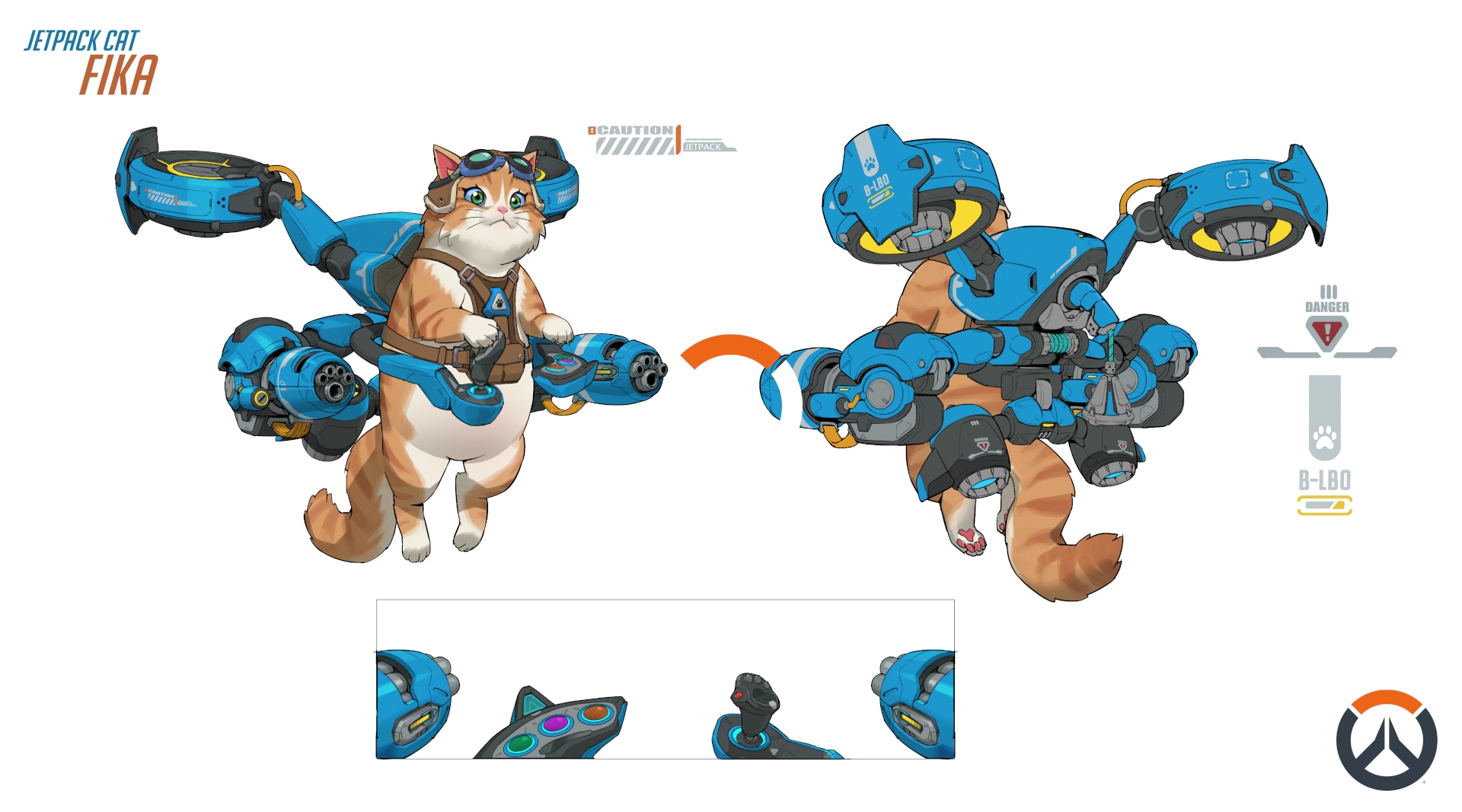
Her jetpack, engineered in lore by Brigitte Lindholm, does a lot of heavy lifting in making Jetpack Cat look like an Overwatch agent. Hard surface artists used specific metal materials and round, friendly shapes to instantly visually code it as Overwatch tech. That way, there was less pressure on Fika herself to blend perfectly into the universe.
Artistically marrying the idea of a suspiciously sentient cat with believability and in-game cohesion was a challenge, albeit a welcome one, for the design teams. Real-life cats have anatomy that makes them arguably less likely to pilot a mech than, say, a human or even a gorilla scientist: they have shoulders that face inward with no peripheral reach. Fika’s 3D model includes small tweaks like flexible shoulders and wider, dilated eyes to make her both more believable in the world of Overwatch and more adorable. (Her pupils turn back into cat-like slits during select animations, though!)
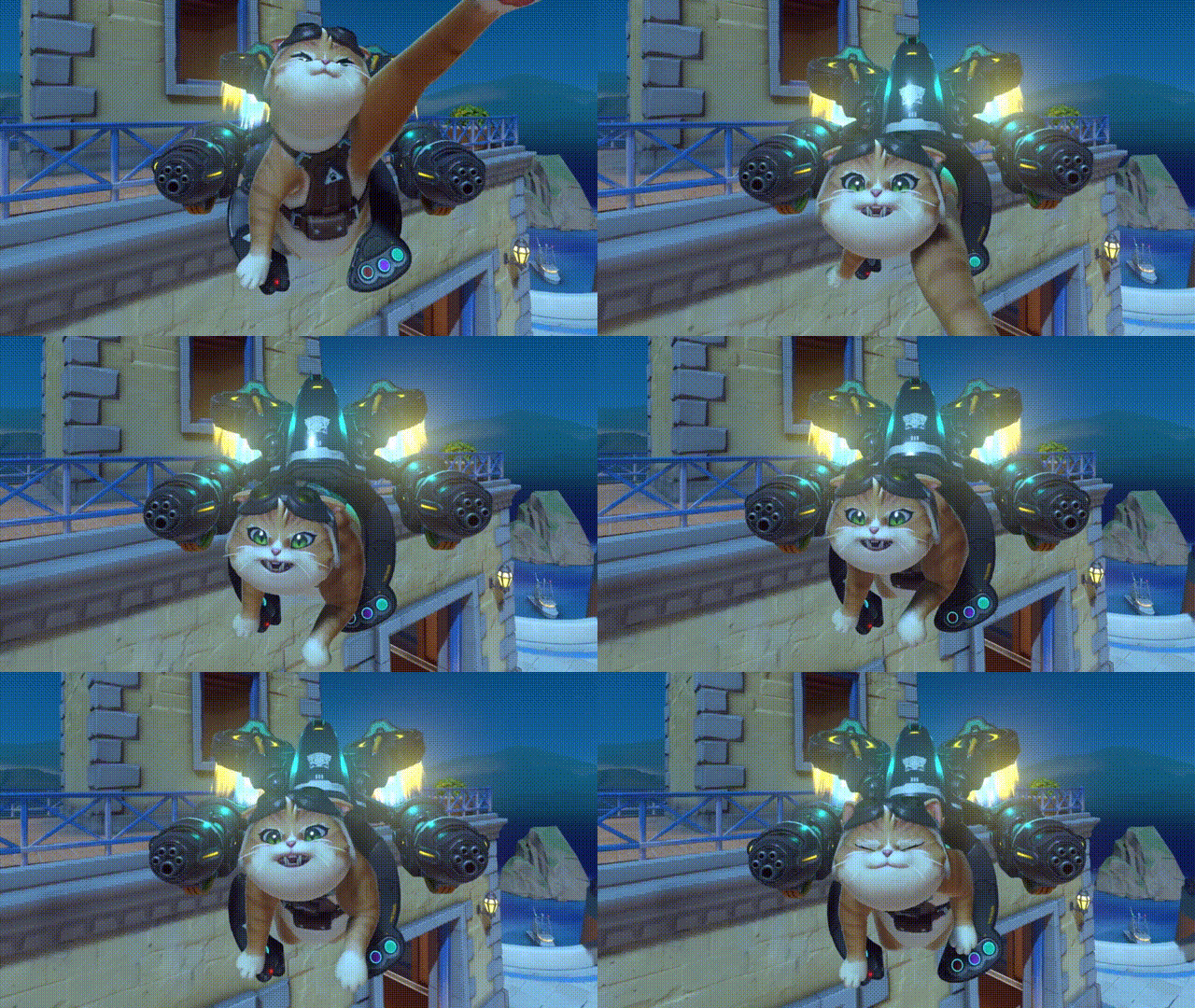
Designing An Aerial Kit(ten)
Far from being put off by the idea of Jetpack Cat as a meme Hero, the Hero Design team was inspired to inject feline chaos into every part of her kit. Many of her abilities borrow from the very real phenomenon of cats knocking over anything they see while her game-changing tether abilities are a nod to the strings and cords that entertain our team's pets. On a sweeter note, the reverberating purrs of cats are said to regulate heartbeats and promote healing; that inspired her area of effect Purr healing ability.
The first building block of her kit was the idea of permanent flight, both a new challenge and opportunity for her strike team. Implementing infinite flight is a tall order, as it has never been done in Overwatch before. But the tradeoff was an easier animation workload: if Jetpack Cat was always airborne, animators didn’t have to tackle the extremely difficult task of animating a quadruped walking with machinery strapped to her back. (Heroes like Pharah, who walk and fly, require two distinct sets of animations.)
Then came Lifeline, an ability derived from a separate Hero concept of a two-seater vehicle Hero with one player controlling movement and another dealing damage (like Cho’Gall in Heroes of the Storm).
Gameplay engineers not only had to figure out the appropriate speed and length of Lifeline tethers, but they had to integrate physics to make things feel fair. For example, enemy tanks are pulled more slowly by Jetpack Cat due to their inherent weight. They even had to adjust attachment points for various Heroes—you wouldn’t grab Tracer and Mauga the same way, right?—and create or modify pickup animations for the entire roster.
That commitment to detail was clawed into every part of Jetpack Cat’s presence within the game, even when challenges started amping up.
Some kit ideas don’t work out quite as well in-game as they do on paper. One of Fika’s initial builds included an Ultimate ability that slowed incoming projectiles, a nod to the lightning-fast reflexes of your average feline. However, when Jetpack Cats on either side of the match used the ult simultaneously, the game server also went into slow motion.
Getting such an unorthodox Hero to fit seamlessly within the roster—sometimes literally—was like threading a needle. The team had to work out the ideal size for Jetpack Cat’s in-game model to promote both cohesiveness and fairness. If her model was too large, it would stick out among the rest of the Hero roster; if it was kitten-sized, players wouldn’t be able to clip Fika’s metal wings. Speed was another balancing act: Jetpack Cat’s zoomies couldn’t be too fast or players would never get a shot in, but movement is critical to her entire kit.
Constant communi-cat-ion (sorry) and intentional design acted as Team 4’s solution to those challenges. During normal Hero design timelines, different teams would meet weekly, split to complete work, then come together to playtest and meet the next week. Season 1’s streamlined production timeline ended up being an advantage for Jetpack Cat’s strike team, who found themselves talking, evaluating solutions, and working together on a much more constant level.
Balancing the Tab(by)
The designers who have let Fika loose into your matches understand that wrangling a furball of chaos is an uphill battle. Our balance team would like to note they have a few laser pointers up their sleeves to further trim Fika’s proverbial nails, if necessary, but her base kit is full of safety measures the team enacted to keep her from becoming the final boss of Overwatch.
Take her gift of infinite flight. To keep enterprising players from hanging out on the top of Lijiang Tower the entire match, most of Jetpack Cat’s abilities are only useful to allies when she’s near them. Purr only heals directly around Fika and her primary fire projectiles have a falloff range, encouraging you to stick by your team. Even her most game-changing ability, Lifeline, removes most of Jetpack Cat’s overall team utility by restricting damage and healing. While that can’t completely discourage you from flying a Bastion around the entire match, it should at least make you think twice about it.
Both paths of the Jetpack Cat—the flying menace or the beacon of healing—are equally valid, and that’s exactly what her designers intended. Nailing the balancing act between chaos and believability was the primary goal of her strike team. At the end of the day, Overwatch is a world full of hope, teamwork, and primate scientists. Competitive satisfaction doesn’t have to come at the cost of fun…but it may take a few sprinkles of catnip.